

Alausa: Universities Must Turn Research Into Businesses, Jobs to Build Nigeria’s $1tn Economy Tasks NASENI, on Research-to-market. By Beauty Akporido Aroh
The Federal Government has challenged Nigerian universities and the National Agency for Science and Engineering Infrastructure (NASENI) to end the culture of research that stops at academic publications and prototypes, insisting that university innovations must be transformed into businesses, jobs and commercially viable products.
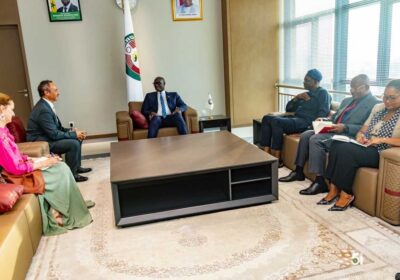
The Minister of Education, Dr. Maruf Tunji Alausa, CON, gave the charge while addressing Vice-Chancellors, Directors of Academic Affairs, Directors of Postgraduate Studies and officials of the Federal Ministry of Education’s Directorate of University Education on a proposed partnership with universities through the NASENI Campus.
Alausa said Nigeria’s ambition of building a $1 trillion economy would remain difficult to achieve unless the country deliberately converts its enormous pool of human capital and research capacity into productive economic activity.
According to him, the missing link is a functional pipeline that takes ideas from the university laboratory through patenting, prototyping, investment and production to the marketplace.
He said the proposed NASENI Campus offered an opportunity to build that ecosystem by bringing researchers, advanced laboratories, prototyping facilities, industries and investors into closer collaboration.
> “Research outputs should not end as academic publications or prototypes,” the Minister stressed, arguing that Nigerian researchers must be supported to patent their inventions, develop marketable products and work with investors to establish viable companies.
Alausa, who drew lessons from the innovation ecosystem around Cambridge, Massachusetts, said Nigeria could replicate such a model by creating stronger connections between universities, research institutions, industry and finance.
He maintained that human capital would only translate into human development when knowledge and innovation generate enterprises, employment and solutions to real economic problems.
NASENI to become bridge between research and industry
The Minister specifically tasked NASENI to establish stronger affiliations with universities located around its development centres, describing the institutions as a huge reservoir of researchers, lecturers and students whose expertise could accelerate the agency’s innovation agenda.
He said NASENI should go beyond developing technologies to helping researchers navigate the commercialisation process, including patent registration, access to venture capital and the establishment of university spin-off companies.
Alausa also challenged the agency to explore opportunities in lithium processing and battery manufacturing, particularly as Nigeria seeks to strengthen its renewable energy and industrial capabilities.
The Minister’s intervention effectively places universities at the centre of the Federal Government’s broader economic diversification strategy, with research expected to become a direct driver of industrialisation rather than an activity confined largely to the academic environment.
NASENI Campus targets research-to-production transition
Earlier, the EVC/CEO of NASENI, Mr. Khalil Suleiman Halilu, outlined the agency’s efforts to close the longstanding gap between research and production.
Halilu said the agency was acting in line with President Bola Ahmed Tinubu’s directive that Nigeria must move beyond prototypes and ensure that innovations ultimately reach the production stage.
He explained that the proposed NASENI Campus, situated within a 100-hectare free trade zone, was being developed as an integrated ecosystem where researchers, professors, prototyping facilities, industries and commercialisation opportunities could operate side by side.
According to him, several factories and industrial facilities are already established within the zone, creating a platform where academic research can be tested, refined and eventually taken to market.
Abuja, BUK partnerships offer early evidence
The University of Abuja is already demonstrating what such university-industry collaboration could produce.
Its Vice-Chancellor, Professor Hakeem Babatunde Fawehinmi, said the university’s partnership with NASENI had resulted in facilities including an integrated agriculture incubation centre, greenhouse facilities, automated poultry systems and tissue culture laboratories.
The facilities, he said, were supporting both undergraduate and postgraduate research, with the university prepared to deepen its partnership with NASENI in areas including dairy science and renewable energy.
At Bayero University, Kano, the commercialisation agenda is also beginning to take shape.
The Vice-Chancellor, Professor Haruna Musa, disclosed that BUK was exploring expanded collaboration with NASENI in nanotechnology, vaccinology, toxinology and mathematical modelling.
More significantly, he revealed that two BUK research projects had reached the final stage of NASENI’s research commercialisation grant process.
The projects include a reusable sanitary pad innovation and the commercial production of sweet potato-based starch derivatives.
The developments point to the possibility of a new model in which university research is assessed not only for its academic value but also for its capacity to solve social problems, create industries and generate employment.
From papers to products
Alausa’s message signals a potentially significant shift in the Federal Government’s approach to university research.
Rather than measuring success primarily through publications, conferences and academic citations, the Ministry wants research institutions to increasingly demonstrate how their innovations can attract investment, create enterprises, support industrial production and generate jobs.
The Minister reaffirmed the Federal Government’s commitment to working with NASENI, universities and other stakeholders to establish a functional pathway linking research, innovation, investment, production and employment.
He said the objective under President Tinubu’s Renewed Hope Agenda was not merely to produce more research, but to ensure that Nigeria’s knowledge, skills and innovations translate into products, businesses, jobs and sustainable prosperity.
For Nigeria’s universities, the message is increasingly clear: the journey of research should no longer end at the laboratory door—it must continue into the factory, the marketplace and ultimately the wider economy.