

Alausa Accelerates Education Reforms, Expands Bilingual Schools to Tackle Out-of-School Crisis By Beauty Akporido Aroh
The Federal Government has intensified its drive to transform Nigeria’s education sector with the unveiling of a state-of-the-art digital e-library at the Federal Government College (FGC), Kano, while reaffirming its commitment to the controversial land swap initiative aimed at upgrading infrastructure in Unity Colleges.
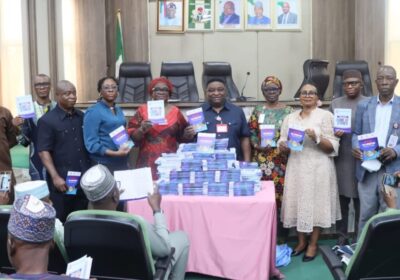
Minister of Education, Dr. Maruf Tunji Alausa, made the declaration during a strategic inspection of key education projects across Kano State, describing the interventions as a demonstration of President Bola Ahmed Tinubu’s Renewed Hope Agenda for Education, which prioritises digital learning, expanded access to quality education and modern infrastructure.
In a strong defence of the proposed Public-Private Partnership (PPP) land swap arrangement at FGC Kano, the Minister insisted that the Federal Government would not abandon the initiative, stressing that responsibly utilising underused portions of school land would generate resources for the construction of modern classrooms, hostels and other critical facilities without compromising the interests of students.
“Our responsibility is to ensure that every policy translates into better opportunities for our students. We have no interest other than providing quality education and improved infrastructure for Nigerian children,” Alausa said.
The Minister also disclosed that the government remains open to engaging the institution’s alumni and other stakeholders willing to partner in the development of the college.
A major highlight of the visit was the commissioning of the newly upgraded digital e-library at Federal Government College, Kano. Powered by solar energy and equipped with air conditioning, modern lighting systems and nearly 80 digital computer workstations, the facility is expected to significantly enhance students’ digital literacy and prepare them for a technology-driven global economy.
Dr. Alausa revealed that the current administration inherited 36 abandoned e-library projects across Unity Colleges, noting that 16 have now been completed and fully rehabilitated through the intervention of the Universal Basic Education Commission (UBEC).
The Minister also inspected the Bilingual School in Ungogo, where construction has reached about 90 per cent completion. He directed that teacher recruitment and other operational preparations begin immediately to ensure the school welcomes its first intake of students in September 2026.
He announced that a third bilingual school would commence academic activities in the 2026 academic session, while a fourth school is expected to open in June 2027.
According to him, the bilingual school initiative represents one of the Federal Government’s most strategic responses to Nigeria’s out-of-school children crisis by integrating Almajiri and other vulnerable children into formal education while providing them with relevant academic knowledge and life skills.
The Minister further disclosed that over one million out-of-school children have been returned to classrooms within the last two years through the Nigeria Education Sector Renewal Initiative, adding that the focus has now shifted to improving learning quality and ensuring sustained school attendance.
At the JICA-supported Junior Secondary School in Lenge, Tofa Local Government Area, Alausa inspected ongoing construction works, including classrooms, perimeter fencing and water, sanitation and hygiene facilities. He announced plans to relocate the junior secondary school to the new site upon completion, while converting the existing structures into a primary school with additional Federal Government support for renovation and furnishing.
The inspection also took the Minister to the National Commission for Mass Education (NMEC) Kano Office and Tarda Smart School, where he assessed programmes designed to strengthen foundational education, promote digital innovation and expand lifelong learning opportunities.
One of the most remarkable moments of the visit came when a student showcased an Artificial Intelligence-powered educational application designed to improve teaching, attendance monitoring, parent-school communication and remote access to learning materials.
Impressed by the innovation, Dr. Alausa directed the UBEC Director of Digital Platforms and Analytics to engage the student with a view to supporting the further development and possible deployment of the application.
Kano State Commissioner for Education, Ali Haruna, commended the Federal Government’s sustained interventions, describing the partnership between the Federal Government and Kano State as instrumental in improving educational access, infrastructure and learning outcomes.
He noted that Governor Abba Kabir Yusuf’s declaration of a state of emergency in education, coupled with increased budgetary allocations, aligns with the Federal Government’s education reform agenda.
As the inspection concluded, the Minister reaffirmed the Ministry’s commitment to delivering practical reforms that will produce better schools, better teachers and better opportunities for every Nigerian child, insisting that investments in digital learning, infrastructure and innovation remain central to building a future-ready education system.