

ECOWAS Must Reclaim Its Peace Legacy Before Others Rewrite West Africa’s History — Afolabi, Christopher Musa By Raymond Enoch
A powerful call is emerging from Abuja for the Economic Community of West African States (ECOWAS) to reclaim, document and defend its own history of regional peace-making, as two senior voices have challenged narratives that diminish the sacrifices of West Africans who fought to end the devastating civil wars in Liberia and Sierra Leone.
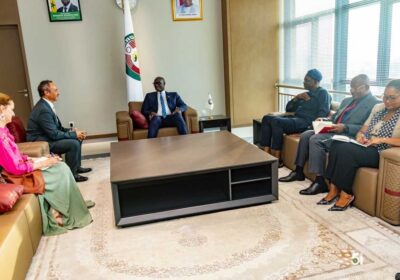
Director of Political Affairs at the ECOWAS Commission, Dr Babatunde Afolabi, and Nigeria’s Minister of Defence, Gen. Christopher Musa (rtd.), delivered a common message from different perspectives: West Africa must tell its own story, preserve the memory of its sacrifices and ensure that the region’s peace-building achievements are not rewritten by outsiders.
Their interventions came in Abuja during the unveiling of new publications documenting ECOWAS’ peacebuilding, peacemaking and peacekeeping interventions, including its historic operations in Liberia, Sierra Leone and Guinea-Bissau.
For a region now confronting terrorism, violent extremism, political instability and the consequences of military takeovers, the speakers argued that the lessons of ECOWAS’ past interventions remain urgently relevant.
‘We Must Tell Our Own Story’
Afolabi said ECOWAS could no longer afford to leave the documentation and interpretation of its peace efforts largely to others.
He called for what he described as the intellectual ownership of the organisation’s peace interventions, warning that inaccurate or incomplete narratives about ECOWAS’ role have circulated for years.
“We need to tell our own story,” Afolabi said, stressing that authoritative documentation was necessary to correct erroneous accounts and ensure that younger generations understand what actually happened during some of West Africa’s darkest years.
His argument goes beyond historical preservation.
For ECOWAS, the issue is increasingly about institutional credibility and regional identity.
The organisation that began in 1975 principally as an economic integration project was compelled by the Liberian civil war to assume a major collective security role. The creation and deployment of the Economic Community of West African States Monitoring Group, ECOMOG, transformed the regional bloc into one of Africa’s most consequential peace and security actors.
Musa: ‘Others Will Write It.
Musa took the argument a step further, challenging narratives that credit foreign powers with liberating Liberia and Sierra Leone while overlooking the African soldiers who fought, suffered and died under the ECOMOG banner.
The Defence Minister recalled that he personally lost 10 of his coursemates from the Nigerian Defence Academy during the Liberian war.
For him, the history of ECOMOG is therefore not an academic debate.
It is personal.
It is also a story of young West Africans who were deployed into extremely dangerous environments because their governments believed that instability in one West African country could ultimately threaten the security and prosperity of its neighbours.
Musa warned that unless Africans document their own experiences, others would inevitably write the history for them.
He also recalled the sacrifice of a young Nigerian officer who, despite advice to remain behind because of his junior status, insisted on joining his colleagues in Liberia and was killed about a year later.
Those sacrifices, Musa argued, should not be reduced to forgotten footnotes.
The debate touches one of the most consequential chapters in modern West African history.
When Liberia descended into civil war, the conflict threatened to spill across borders, creating refugee flows, disrupting trade and exposing neighbouring states to insecurity.
ECOMOG’s intervention in Liberia in 1990 represented an unprecedented attempt by West African states to collectively confront a security crisis within the region.
Nigeria emerged as the principal military and logistical contributor, while other West African countries also participated.
ECOMOG subsequently played a major role in Sierra Leone, where another brutal civil war had devastated the country.
The interventions were not without controversy, mistakes or costs. Afolabi himself stressed the importance of learning from both successes and shortcomings.
But the central message from Abuja was that the region should not allow the complexities of those interventions to erase the sacrifices made by West Africans.
Perhaps the most compelling dimension of the Abuja gathering was its reminder that regional peace was not achieved merely through communiqués and diplomatic negotiations.
Soldiers died.Civilians were displaced.
Journalists entered conflict zones and sometimes never returned.
Former ECOMOG commanders were honoured during the event, alongside journalists who covered the wars, including Nigerian reporters who lost their lives while documenting the conflicts.
Afolabi therefore called for recognition of the member states, citizens, military personnel and other actors whose sacrifices helped restore peace.
That recognition, he said, must extend beyond ceremonies.
It must become part of the institutional memory of ECOWAS and the collective consciousness of West Africa.
The timing of the debate could hardly be more significant. West Africa is again facing a complex security environment, with terrorism and violent extremism spreading across parts of the Sahel, political instability testing regional solidarity and the wider consequences of insecurity threatening borders, economies and communities.
Musa warned that allowing asymmetric warfare to become entrenched could produce consequences far more difficult to reverse.
He also argued that military force alone cannot resolve modern security crises, estimating that kinetic operations account for only about 30 per cent of the solution, with the remaining 70 per cent requiring non-kinetic responses.
For ECOWAS, the lesson from Liberia and Sierra Leone is therefore not simply that the organisation once deployed troops.
It is that regional solidarity can matter when national borders are threatened by problems that no single country can solve alone.
The challenge now is whether the organisation can translate that historical experience into a renewed regional security doctrine capable of responding to today’s realities.
The Abuja conversation ultimately places ECOWAS before a larger question: What should West Africa remember from its past as it confronts its future?
Afolabi’s call for intellectual ownership and Musa’s insistence that Africans must tell their own story converge on one fundamental proposition — a region that forgets the sacrifices through which its peace was built risks losing the institutional courage required to defend that peace.
The publications unveiled in Abuja, including Fighting Bushfires: ECOWAS and Peacemaking in West Africa – The Experience and Learning Curves, seek to preserve those lessons and make them accessible to policymakers, researchers and younger generations.
For the millions of West Africans who did not witness the wars in Liberia, Sierra Leone and Guinea-Bissau, the message is particularly important.
The peace they inherited was not inevitable,
It was fought for.
And, as Abuja’s latest intervention makes clear, West Africa now has a responsibility not only to remember those who paid the price for peace, but to ensure that their sacrifices continue to shape the region’s response to the new threats confronting it