

FG Pledges Citizen-Centred Diplomacy, Economic Value Creation and Stronger Foreign Service Institutions By Raymond Enoch
The Federal Government has unveiled plans to undertake far-reaching reforms in Nigeria’s foreign policy institutions, signaling a fresh push to align diplomacy more closely with national development priorities, economic growth and the welfare of citizens at home and abroad.
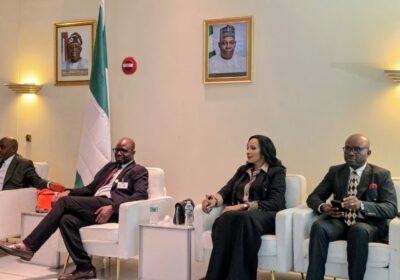
This indication emerged when the Honourable Minister of State for Foreign Affairs, Shola Enikanolaiye, received a delegation of the Association of Retired Career Ambassadors of Nigeria led by its Chairman, Joe Keshi, at the Ministry of Foreign Affairs in Abuja.
The high-level engagement, which brought together serving and retired diplomats, focused on institutional reforms, economic diplomacy, citizen protection, and strategies for repositioning Nigeria’s diplomatic service to meet emerging global challenges.
Speaking during the meeting, Ambassador Enikanolaiye said the Ministry was undergoing a strategic review aimed at strengthening its operational capacity and ensuring that Nigeria’s foreign policy delivers measurable benefits to citizens.
He stressed that the country’s diplomatic engagements would continue to be guided by the administration’s people-centred foreign policy framework anchored on the “4-Ds” — Demography, Development, Democracy and Diaspora — while placing greater emphasis on economic value creation.
According to the Minister, diplomacy must go beyond traditional state-to-state relations and become a tool for attracting investment, expanding trade opportunities, creating jobs and advancing Nigeria’s development agenda.
“The welfare, security and prosperity of Nigerians must remain at the centre of foreign policy formulation and execution,” he stated, while advocating stronger economic diplomacy and innovative approaches to funding Nigeria’s diplomatic missions abroad.
Observers view the renewed emphasis on economic diplomacy as part of the Federal Government’s broader effort to leverage international partnerships for domestic economic transformation amid growing global competition for investment and markets.
The Minister also outlined plans to strengthen the institutional foundation of the Foreign Affairs Ministry through enhanced capacity building, improved records management systems and administrative reforms designed to improve efficiency and policy implementation.
In a move likely to resonate across the diplomatic community, Ambassador Enikanolaiye assured retired Foreign Service officers that government remained committed to addressing lingering pension and welfare concerns affecting former diplomats.
The meeting also touched on recent developments involving Nigerians residing in South Africa. The Minister reaffirmed Nigeria’s determination to protect its citizens abroad through dialogue and diplomatic engagement, revealing that efforts were underway to reactivate key bilateral platforms such as the Nigeria-South Africa Bi-National Commission and the Early Warning Mechanism.
He noted that strengthening relations with neighbouring countries, the Sahel region and strategic international partners remained essential to promoting regional stability, national security and economic development.
Earlier, Ambassador Keshi congratulated the Minister on his appointment and pledged the support of retired career ambassadors toward advancing Nigeria’s foreign policy objectives.
The veteran diplomat called for sustained investment in the training and professional development of Foreign Service officers, warning that a rapidly changing international environment requires highly skilled diplomats capable of navigating complex geopolitical and economic realities.
Keshi further advocated the effective use of bilateral mechanisms to address challenges in Nigeria’s relations with key partners, particularly South Africa, where concerns involving Nigerian citizens have periodically strained public perceptions.
Political and diplomatic analysts say the engagement underscores a growing recognition within government circles that Nigeria’s diplomatic strength lies not only in its international influence but also in the institutional resilience of its Foreign Service.
The meeting ended with both sides reaffirming their commitment to deeper collaboration in driving reforms, preserving diplomatic excellence and ensuring that Nigeria’s foreign policy serves as a catalyst for national development and global relevance.
For many observers, the gathering represented more than a routine courtesy visit; it signaled an emerging consensus between serving and retired diplomats that Nigeria’s foreign policy must evolve from a largely political instrument into a strategic platform for economic growth, citizen protection and national transformation.