

FAO–Lagos Red Meat & Coconut Roundtable Closes with Clear Investment Pathways and Renewed Private Sector Confidence By Raymond Enoch
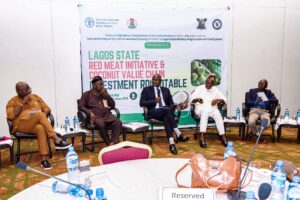
The two-day Lagos State Red Meat and Coconut Value Chain Investment Roundtable, jointly organized by the Food and Agriculture Organization of the United Nations (FAO) and the Lagos State Ministry of Agriculture and Food Systems, has concluded with strong momentum, delivering concrete outcomes and a clear roadmap for scaling sustainable agrifood investments in Nigeria’s commercial hub.
Held in Lagos, the high-level engagement brought together policymakers, development partners, investors, agribusiness leaders and technical experts to unlock the investment potential of the red meat and coconut value chains—two sectors identified as critical to food security, job creation and inclusive economic growth.
At the close of deliberations, stakeholders aligned around three key priorities: coordinated technical assistance, stronger public–private partnerships, and a practical pathway for scaling bankable, sustainable agrifood investments across Lagos State.
Participants emphasized the need for targeted technical support to improve productivity, food safety standards, climate resilience and value addition, while ensuring that smallholder producers and SMEs are fully integrated into emerging market opportunities. The roundtable also reinforced the role of government as an enabler—providing policy certainty, infrastructure and regulatory clarity—to crowd in private capital.
Speaking on the outcomes, stakeholders noted that the convergence of public institutions, development partners and investors at one table marked a shift from dialogue to action. Commitments were made to deepen collaboration, accelerate project preparation and move viable investment concepts toward implementation.
The focus on the red meat and coconut value chains aligns with FAO’s #4Betters framework—better production, better nutrition, a better environment and a better life—and Lagos State’s broader food systems transformation agenda. With Lagos’ large consumer market and strategic position in regional trade, participants agreed that successful models developed in the state could be scaled nationally and across West Africa.
As the roundtable closed, organizers confirmed that follow-up engagements will concentrate on investment matchmaking, technical assistance deployment and monitoring of agreed next steps, ensuring that the momentum generated translates into tangible outcomes for producers, investors and consumers alike.