

H.E. General Birame DIOP Assumes ECOWAS Presidency, Partners Media on Proactive Reporting, Misinformation By Raymond Enoch
The new President of the ECOWAS Commission, H.E. General Birame DIOP of Senegal, has assumed office with a renewed call for unity, institutional strengthening and proactive engagement with the media to confront misinformation and improve public understanding of regional integration.
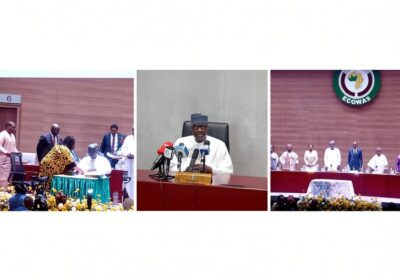
General DIOP formally took over from H.E. Dr. Omar Alieu TOURAY of The Gambia at a high-level welcome and send-off ceremony held at the new ECOWAS Commission headquarters in Abuja, marking the beginning of a new four-year leadership cycle for the regional institution.
The ceremony also witnessed the assumption of office by Nigeria’s H.E. Mr. Anthony OGUNJIMI as Vice President, succeeding H.E. Mrs. Damtien TCHINTCHIBIDJA of Togo.
Other new statutory appointees include Dr. Kalilou SYLLA of Côte d’Ivoire, Commissioner for Internal Services; Mrs. Francess ALGHALI of Sierra Leone, Commissioner for Political Affairs, Peace and Security; Mr. Dehpue Yenpea ZUO of Liberia, Commissioner for Economic Affairs and Agriculture; and Mr. Amin Amidu SULEMANI of Ghana, Commissioner for Infrastructure, Energy and Digitalisation.
Also assuming office are Prof. Nassirou BAKO-ARIFARI of Benin, Commissioner for Human Development and Social Affairs; Ms. Carla Maria Borges BETTENCOURT of Cabo Verde, Auditor-General for ECOWAS Institutions; Dr. Palokinam PITCHE of Togo, Director-General of the West African Health Organisation (WAHO); and Mr. Mam Cherno JALLOW, Director-General of the Inter-Governmental Action Group against Money Laundering in West Africa (GIABA).
The transition featured the unveiling of the ECOWAS@50 Special Exclusive Publication by Africa Agenda Network in partnership with the ECOWAS Commission, the presentation of the Management Performance Compendium to the incoming President and the signing of formal handover notes by the outgoing and incoming leadership.
In his farewell address, Dr. Touray reflected on his four-year tenure, expressing gratitude for the opportunity to serve the Community and stressing that the outgoing administration was leaving behind not merely “memories, speeches and decisions,” but a record of institutional and regional accomplishments.
For General DIOP, however, the assumption of office comes at a defining moment for ECOWAS, which he acknowledged had reached a crossroads, particularly following the political and institutional challenges confronting the region.
He pledged to do everything humanly possible to live up to the expectations of his mandate, while congratulating the outgoing Commission under Touray for its work.
The new President identified dialogue with the Alliance of Sahel States (AES), the political crisis in Guinea-Bissau, implementation of the first five years of the ECOWAS Vision 2050, financing regional programmes, strengthening institutional cohesion and giving citizens greater opportunity to have a voice in the affairs of the Community as key areas requiring attention.
He also raised concerns over regional security and the need to determine how the ECOWAS Standby Force (ESF) can be effectively operationalised, insisting that the Community has “no alternative” to building a strong institution capable of delivering on its mandate.
But beyond institutional reforms, General DIOP placed particular emphasis on communication, public confidence and the role of the media in shaping the future of regional integration.
With misinformation and distorted narratives increasingly influencing public perception of ECOWAS, the new administration is expected to deepen engagement with journalists and media organisations, encouraging proactive, factual and responsible reporting that brings the work of the Community closer to its citizens.
His appeal for citizens to have a stronger voice in ECOWAS therefore places the media at the centre of the new leadership’s strategy: a stronger, more cohesive ECOWAS cannot be built only within its institutions; it must also be communicated effectively to the people, with the media serving as a critical bridge against misinformation, public distrust and distorted narratives about regional integration.