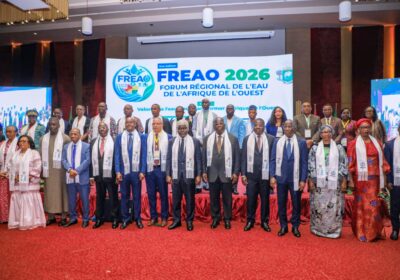


ECOWAS Validates Inter-Institutional Communication Strategy (2026–2030) and Information and Communication Policy for ECOWAS Institutions in Cotonou By Raymond Enoch
COTONOU, BENIN REPUBLIC – The Economic Community of West African States (ECOWAS) has commenced a high-level technical workshop in Cotonou to validate its ECOWAS Inter-Institutional Communication Strategy (2026–2030) and the Information and Communication Policy for ECOWAS Institutions, marking a decisive step toward strengthening institutional coherence and public engagement across the region.
The five-day exercise, which opened on 23 February and runs through 27 February 2026, is convened by the ECOWAS Commission’s Communications Directorate with support from the Government of Germany. It brings together heads of communication, directors, technical experts and development partners to refine what officials describe as a transformative framework designed to ensure the regional body speaks with clarity, consistency and credibility.
Representing the President of the ECOWAS Commission, H.E. Dr Omar Alieu Touray, the Senior Adviser to the President, Prof. Abdoulie Gassama, said communication must move in tandem with reform.
“Reforms achieve their full value only when they are clearly understood, widely supported, and collectively owned by the people they are meant to serve,” he declared while opening the workshop.
He stressed that ECOWAS institutions must communicate more effectively with over 400 million citizens across West Africa, particularly in a digital era shaped by artificial intelligence, disinformation and shifting public trust.
According to Prof. Gassama, achieving that vision requires not only sound policies and programmes but also the ability to communicate clearly, consistently and credibly with citizens, stakeholders and partners.
In a goodwill message, Ms. Rike Sohn, Acting Head of Mission at the German Embassy in Benin Republic, reaffirmed Germany’s strategic support for ECOWAS, describing communication as a critical pillar of governance, institutional resilience and regional integration.
The validation process is closely aligned with ECOWAS Vision 2050 — the Community’s long-term development blueprint aimed at building a fully integrated, peaceful, prosperous and people-centred West Africa anchored on strong institutions and respect for fundamental rights and freedoms.
Participants are reviewing both the Communication Strategy (2026–2030) and the revised Information and Communication Policy to ensure alignment with institutional priorities, evolving digital realities and the strategic objectives of the Commission.
Over the years, ECOWAS has expanded its operational footprint across peacekeeping, governance, infrastructure development, trade liberalisation and regional integration. However, officials acknowledge that fragmented messaging and uneven communication capacity across institutions have sometimes limited the Community’s visibility and impact.
The new framework is designed to address those gaps by harmonising messaging structures, strengthening stakeholder engagement, enhancing data protection standards and promoting the responsible use of artificial intelligence in institutional communication.
Communication officers from ECOWAS directorates, agencies and specialised institutions are participating in technical sessions focused on narrative management, countering misinformation, digital engagement tools and projecting the achievements of the Community more effectively.
Organisers describe the Cotonou meeting as the final milestone before formal adoption of the documents. The workshop is expected to produce consensus-driven recommendations that will6 guide communication practices across all ECOWAS institutions from 2026 onward.
Participants include former acting directors of communication, heads of communication and information divisions, representatives of partner organisations such as GIZ and NIRAS, and senior ECOWAS officials.
Observers note that in a region navigating democratic transitions, security challenges, youth unemployment pressures and rapid technological transformation, strategic communication is no longer optional but foundational to institutional legitimacy and public trust.
As deliberations continue in Cotonou, ECOWAS experts in the workzhop express confidence that the validation process will yield a harmonised communication framework capable of reinforcing institutional coherence, strengthening public confidence and bringing the Community closer to its people.
“I am confident that the outcomes of your deliberations will significantly strengthen ECOWAS communication, reinforce institutional coherence, and bring the Community closer to its people,” Prof. Gassama said.
With the validation of the ECOWAS Inter-Institutional Communication Strategy (2026–2030) and the Information and Communication Policy for ECOWAS Institutions now underway, the regional institution signals its determination to ensure that West Africa’s integration story is not only built in policy rooms but clearly told to its citizens and the world.