

Gender Equality Seal for Public Institutions Launched as ECOWAS Advances Inclusive Governance in West Africa By Raymond Enoch
The Economic Community of West African States (ECOWAS) has taken a decisive step toward institutionalizing gender-responsive governance with the formal introduction of the Gender Equality Seal for Public Institutions (GES-PI) within its institutions, beginning with the ECOWAS Bank for Investment and Development (EBID).
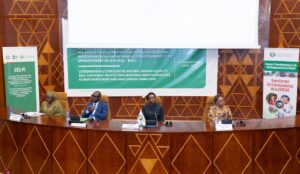
The landmark coordination and evaluation meeting, held today Wednesday 17th December 2025 at the EBID Conference Hall in Lomé RepublicofTogo, signals ECOWAS’ renewed commitment to embedding gender equality at the core of public-sector leadership, policy formulation, and development finance across West Africa. The initiative positions EBID to emerge as a regional reference institution for inclusive governance and gender-responsive development practice.
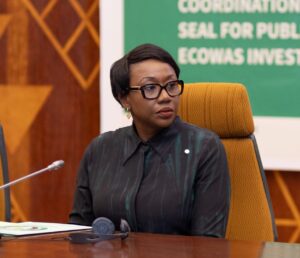
Presiding over the meeting, is Her Excellency. Mrs. Damtien Tchintchibidja, Vice-President of the ECOWAS Commission, described the GES-PI as a transformative tool rather than a symbolic gesture. She emphasized that gender equality must be reflected not only in policy statements but in institutional culture, decision-making processes, budgeting frameworks, and measurable outcomes.
> “The Gender Equality Seal for Public Institutions is about accountability, standards, and results. It is a practical framework that enables ECOWAS institutions to walk the talk of inclusion and equity,” she said.
The GES-PI, initiated by the United Nations Development Programme (UNDP), is a globally recognized certification framework designed to assess, support, and reward public institutions that demonstrate concrete progress toward substantive equality between women and men. It aligns directly with the 2030 Agenda for Sustainable Development, particularly Sustainable Development Goal 5 on gender equality, while strengthening institutional effectiveness overall.
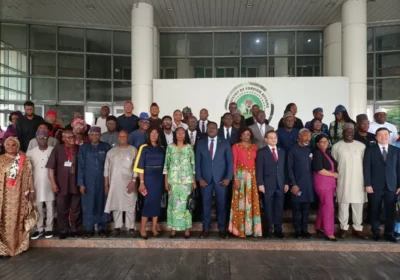
Organised by the ECOWAS Gender Development Centre (EGDC), the high-level technical meeting brought together key regional and international stakeholders, underscoring the strategic importance of the initiative. Among the dignitaries in attendance were H.E. Dr. George Agyekum Donkor, President of EBID; Mrs. Binta Sanneh, UNDP Resident Representative in Togo; and H.E. Mrs. Emily Grey, ECOWAS Resident Representative in Togo. Senior technical directors from the ECOWAS Commission, the ECOWAS Court of Justice, EBID, and partner institutions also participated.
In his remarks, Dr. Donkor reaffirmed EBID’s readiness to serve as a pilot institution for the Seal, noting that development finance institutions must reflect the inclusivity they promote. He highlighted that integrating gender equality into EBID’s internal systems would strengthen the bank’s impact, credibility, and responsiveness to the needs of West African citizens.
For UNDP, the rollout of the GES-PI within ECOWAS marks a strategic expansion of a proven global framework into regional governance structures. Mrs. Sanneh noted that institutions that meet the Seal’s benchmarks often experience improved performance, stronger accountability, and more sustainable development outcomes.
Beyond certification, discussions at the meeting focused on implementation pathways, institutional self-assessment, capacity building, and monitoring mechanisms required to ensure that gender equality commitments translate into lasting change.
As ECOWAS deepens its integration agenda, the introduction of the Gender Equality Seal for Public Institutions sends a clear message: inclusive governance is no longer optional—it is central to the region’s development, stability, and future prosperity.