

Nigeria Secures €50m Boost for Local Drug Manufacturing in Landmark EU–BOI Deal By Raymond Enoch
Nigeria has taken a decisive step toward transforming its healthcare and industrial landscape following the signing of a €50 million financing agreement between EIB Global and the Bank of Industry (BOI), aimed at accelerating local production of medicines, vaccines, and diagnostic tools.
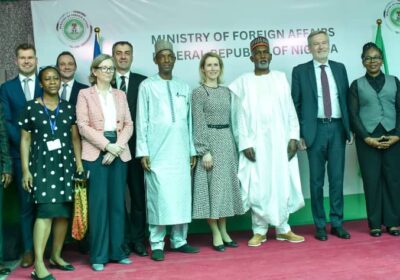
The landmark agreement, unveiled on the sidelines of the Nigeria–EU Ministerial Summit in Abuja, signals a strategic shift from heavy dependence on imported medical supplies to building a resilient, self-sufficient healthcare manufacturing ecosystem.
Backed under the European Union’s flagship Global Gateway programme, the facility will be disbursed as a credit line to Nigerian manufacturers, particularly small and medium-sized enterprises (SMEs), enabling them to scale production and meet international quality standards.
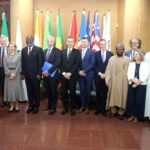
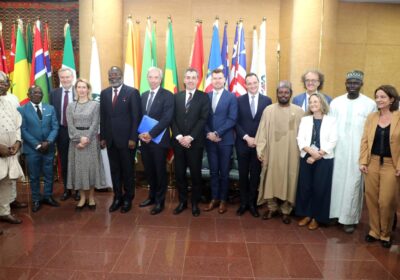
The announcement was made in the presence of key stakeholders, including Svetla Stoeva, Olasupo Olusi, Abubakar Atiku Bagudu, and Gautier Mignot.
The initiative is designed to tackle Nigeria’s longstanding healthcare supply gaps by supporting domestic production of essential pharmaceuticals and medical products. It also aligns with broader continental ambitions under the African Union to locally produce 60 percent of vaccines and essential medicines by 2040.
Speaking at the signing, BOI Managing Director, Olasupo Olusi, described the partnership as a “pivotal step” in repositioning Nigeria within global healthcare value chains.
“This collaboration moves Nigeria from being a major importer of essential health commodities to becoming a competitive producer,” Olusi said. “It is not only about health security—it is about industrial growth, job creation, and long-term economic resilience.”
He emphasized that the funding would provide “patient capital,” a form of long-term financing critical for industries like pharmaceuticals that require significant upfront investment and time to mature.
For European Investment Bank Vice President Ambroise Fayolle, the agreement underscores Europe’s commitment to improving lives through sustainable investments.
“By financing local manufacturing, we are enhancing access to affordable, safe, and high-quality treatments,” Fayolle stated. “This partnership strengthens Nigeria’s health security and improves the resilience of supply chains.”
Similarly, Jozef Sikela noted that the initiative would reduce Nigeria’s reliance on imports while empowering local industries.
“We are investing so Nigeria can produce more of what it needs at home,” Sikela said, adding that the deal would strengthen regional value chains and create new economic opportunities.
The project is financed under the Human Development Accelerator (HDX), a joint initiative supported by the European Commission and the Gates Foundation. The programme focuses on mobilising private-sector investment into critical sectors such as healthcare.
It also aligns with the Team Europe Initiative for Manufacturing and Access to Vaccines (TEI MAV+), reinforcing collaborative efforts between Europe and Africa to boost health sector resilience.
Beyond healthcare, the investment is expected to deliver wide-ranging economic benefits. By strengthening local production capacity, Nigeria could reduce its import bill, improve its trade balance, and create high-quality jobs across the pharmaceutical value chain.
The initiative also opens doors for regional exports within the ECOWAS market, while fostering stronger business linkages with European firms.
Analysts say the deal could position Nigeria as a pharmaceutical hub in West Africa, particularly under the African Continental Free Trade Area framework.
EIB Global’s engagement in Nigeria is not new. Since 1978, the institution has invested approximately €2.3 billion in sectors ranging from transport and climate adaptation to digital innovation and agribusiness.
For BOI, the partnership builds on its track record of supporting over one million enterprises between 2023 and 2025, with disbursements exceeding ₦1.27 trillion.
As Nigeria grapples with rising healthcare demands and economic diversification challenges, the €50 million agreement represents more than just funding—it is a blueprint for sustainable development driven by strategic partnerships.
With global backing and local execution, stakeholders believe the initiative could mark the beginning of a new era—one where Nigeria not only meets its healthcare needs but also emerges as a key player in Africa’s pharmaceutical industry.
For a country long reliant on imports, the message is clear: the future of healthcare in Nigeria is being built at home.