

ECOWAS Holds Firm on Development, Backs EBID Autonomy as Region Defies Global Economic Slowdown, Projects 5% Growth in 2026. By Raymond Enoch
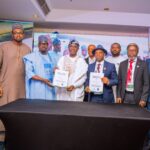
The Economic Community of West African States (ECOWAS) has projected confidence and institutional resolve in the face of global economic uncertainties. This was disclosed by the ECOWAS President, Dr. Omar Alieu Touray, during a high level meeting with Development Partners in Abuja ,Nigeria. He reassured international development partners of the region’s resilience, macroeconomic stability, and commitment to safeguarding development finance from political disruption.
Addressing a high-level meeting with development partners in Abuja, Dr. Touray said global economic growth slowed in 2025, but West Africa outperformed both global and continental averages, recording a growth rate of 4.6 percent, with projections of five percent in 2026. He attributed the region’s performance to sustained structural reforms, increased investment in mining and energy, improved trade facilitation, and a rebound in services, transport, and tourism.
Although inflation remains elevated in parts of the region, Dr. Touray noted a significant decline in several member states, supported by coordinated monetary policies and improved food supply conditions. Fiscal deficits have narrowed as governments strengthened revenue mobilisation and rationalised public spending, while debt-to-GDP ratios declined modestly on the back of strong nominal growth and improved macroeconomic management. He said the region’s external position remains sound, supported by export earnings from oil, gold, and bauxite.
Responding to solidarity abd cautious quesions from partners , the ECOWAS President defended the decision to preserve engagement with Burkina Faso, Mali and Niger within the ECOWAS Bank for Investment and Development (EBID), warning that halting ongoing projects valued at nearly 230 million dollars would endanger the Bank’s financial stability, undermine investor confidence, and widen infrastructure gaps across the sub-region.
He disclosed that EBID disbursed approximately 429 million dollars in 2025, but faces an exposure of about 280 million dollars in the three countries, alongside active projects nearing 230 million dollars.
According to him, suspending those operations would worsen poverty and security challenges at a time when development financing remains critical to regional stability.
Dr. Touray said the issue was first discussed at the Extraordinary Council of Ministers meeting in Accra in April 2025, after which EBID’s Board of Governors, at its 13th Extraordinary Session, resolved to allow the three countries to continue working with the Bank and retain their staff. The decision, he explained, is consistent with Article 21.2 of the ECOWAS Treaty and the Supplementary Act establishing EBID’s institutional autonomy, and has been forwarded to the Authority of Heads of State and Government for endorsement.
On security, the ECOWAS President acknowledged persistent instability in parts of the region, noting that while attacks declined slightly in 2025, fatalities increased due to the growing use of improvised explosive devices. He said reduced security cooperation with the AES bloc has complicated counter-terrorism efforts, even as ECOWAS intensified preventive diplomacy, rotated the Standby Force, reinforced its 1,650-strong Counter-Terrorism Brigade, and assumed control of the West Africa Police Information System from Interpol.
He reaffirmed the bloc’s zero-tolerance policy for unconstitutional changes of government, citing ECOWAS’ swift response to the attempted coup in Benin, and expressed concern over the aborted elections in Guinea-Bissau, where the organisation is advocating for a short, inclusive transition with a limited mandate to deliver constitutional and electoral reforms.
Dr. Touray also announced the lifting of all sanctions on the Republic of Guinea following elections deemed credible by ECOWAS mediation structures, officially restoring the country as a full member of the regional bloc.
He described the development as a major milestone for democratic restoration and regional unity.
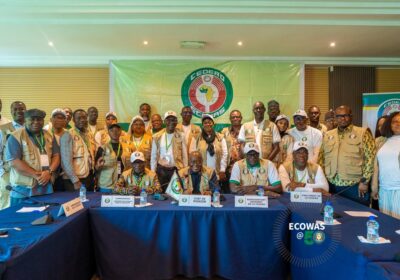
The meeting was attended development partners the UN system, the European Union, African Development Bank, French Development Agency, GIZ and the German Embassy and several others.
As ECOWAS continue to mark its 50th anniversary and plan fot the future, Dr. Touray said the Commission has continued to advance regional integration through the ECOVISA online platform, biometric identity systems, expanded AfCFTA participation, investments in infrastructure, energy, digital connectivity, food security, and targeted support for women and youth.
He concluded that while ECOWAS faced significant challenges in 2025, the progress recorded reflects the resilience, determination and unity of the community, reaffirming that the vision of a peaceful, prosperous and fully integrated West Africa remains within reach.