

Democracy in Guinea-Bissau as President Bio Leads High-Level Mission.
By Raymond Enoch
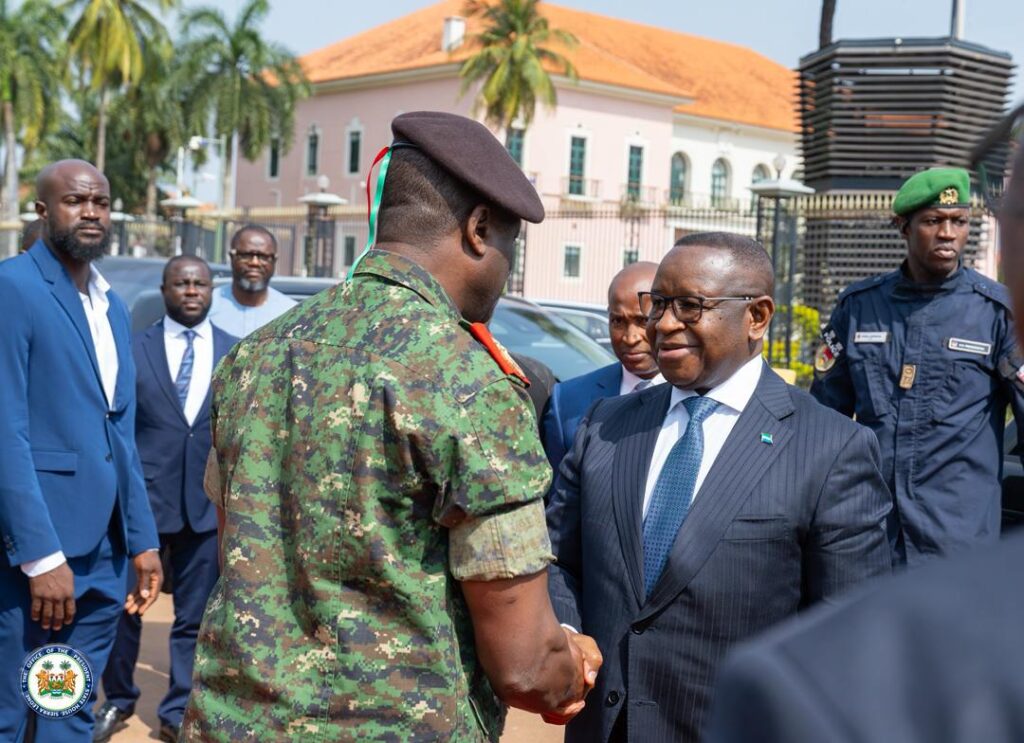
In a decisive diplomatic push to prevent further instability in West Africa, the Chairman of the ECOWAS Authority of Heads of State and Government, His Excellency President Julius Maada Bio of Sierra Leone, on Monday 1st December 2025, led a high-level engagement in Bissau aimed at steering Guinea-Bissau back to constitutional rule following what regional political analysts and scholars described as “a military maneuver of power”, in which former President Umaro Sissoco Embaló—who was a candidate in an election perceived to have been concluded—was said to have staged managed the crisis.
Sierra Leone’s Minister of Foreign Affairs and International Cooperation, His Excellency Timothy Musa Kabba, speaking at the close of Day One of the mission, delivered a firm communiqué that captured ECOWAS’ unified position.
“On behalf of ECOWAS, His Excellency, the President of the Authority, condemned the coup d’état and called for the immediate restoration of constitutional order,” Kabba declared. “This includes allowing the electoral process to be carried through to a logical conclusion.”
Kabba emphasized that the mission stems from the Extraordinary Virtual Summit of ECOWAS Heads of State held on 27 November 2025, where President Bio was mandated to personally engage Guinea-Bissau’s transitional authorities. He described Monday’s exchanges as “very productive,” noting that both sides were forthright in expressing their concerns.
According to the Foreign Minister, ECOWAS made it clear that the unconstitutional removal of the elected president could not be legitimized under any circumstance. He stressed that “no rationale can supersede constitutional governance,” adding that West Africa’s political stability depends on the unwavering protection of democratic norms.
In a response, senior military officers defended their alleged capture of the reins of power, stating that their intervention was intended “to ensure the restoration of order and security in the country.” While ECOWAS took note of their arguments, Kabba stressed that the region expects a credible and time-bound return to democratic rule.
Accompanied by Dr. Omar Alieu Touray, President of the ECOWAS Commission; Leonardo Santos Simão, the Special Representative of the UN Secretary-General for West Africa and the Sahel; and Alhaji Timothy Musa Kabba, Sierra Leone’s Minister of Foreign Affairs and Chair of the ECOWAS Executive Council, President Bio’s delegation held a series of high-level engagements with national institutions and stakeholders.
During the visit, President Bio and his delegation also met with the Electoral Commission of Guinea-Bissau, where its Chairman and other members provided a detailed briefing on the current electoral situation, the operational challenges, and the steps required to conclude the interrupted process.
“We look forward to continuing this dialogue in order to return the country to the constitutional path and to promote the development, security, and stability of Guinea-Bissau and its people,” Kabba reiterated.
Diplomatic analysts say President Bio’s mission represents a critical test of ECOWAS’ resolve amid a wave of coups in the region. The bloc’s credibility, they argue, hinges on its ability to secure a viable and accountable transition in Bissau.
As talks progress, ECOWAS is expected to push for concrete commitments on a transition timetable, electoral guarantees, and assurances for national stability. International partners are watching closely, viewing the mission as a crucial step in preventing Guinea-Bissau from sliding deeper into political uncertainty.
The delegation is expected to brief regional leaders after concluding its engagement, amid cautious optimism that sustained dialogue may yet deliver a peaceful and constitutional settlement.