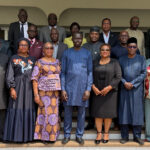


Guinea-Bissau Take Centre Stage at ECOWAS Court Compliance Talks in Conakry By Raymond Enoch
Discussions around cases involving Guinea-Bissau unexpectedly dominated deliberations when the Community Court of Justice, ECOWAS convened a bilateral meeting in Conakry from 2–4 March 2026 to review how the government of Guinea is enforcing the Court’s decisions. What began as a routine engagement to assess compliance quickly broadened into a deeper conversation about regional enforcement challenges, with participants citing the political and legal complexities surrounding Guinea-Bissau’s cases as key examples shaping the Court’s approach.
The meeting brought together senior national officials, judicial authorities and other stakeholders to examine the status of implementation of rulings delivered by the regional court. It also focused on identifying obstacles that often delay enforcement at the national level and exploring practical steps that can strengthen cooperation between the Court and member states.
Leading the Court’s delegation was its President, Ricardo Cláudio Monteiro Gonçalves, who emphasized the importance of sustained dialogue with national authorities to ensure that decisions of the regional court are effectively implemented. Participants noted that the effectiveness of the Court ultimately depends not only on its judgments but also on the willingness and capacity of member states to enforce them.
According to officials familiar with the discussions, references to Guinea-Bissau emerged repeatedly during the sessions because several cases from the country have highlighted broader issues affecting enforcement across the region. These include political sensitivities surrounding certain rulings, delays in domestic legal processes and the need for stronger coordination between regional institutions and national governments.
The Conakry meeting therefore served as a platform for sharing lessons and exploring how similar challenges can be avoided in other member states, including Guinea. Participants stressed that improving compliance mechanisms is essential for strengthening the credibility of the Court and reinforcing the rule of law within the regional bloc.
The bilateral engagement forms part of activities marking the 50th anniversary of the Economic Community of West African States. As part of the same initiative, the Court’s delegation has also held similar consultations with authorities in Sierra Leone and Nigeria, in a broader effort to deepen cooperation with member states and promote greater respect for the Court’s judgments across the region.
Observers say such engagements are becoming increasingly important as the regional court continues to handle cases involving human rights, governance disputes and state obligations. Strengthening enforcement, they note, remains a key step toward ensuring that decisions delivered in the courtroom translate into real change within member states.