

NAF, NIMASA FORGE POWER PARTNERSHIP TO DEFEND NIGERIA’S BLUE ECONOMY As Mobereola, Aneke deepen air–maritime security architecture By Raymond Enoch
In a decisive move to consolidate Nigeria’s maritime security gains and safeguard the nation’s expanding blue economy, the Nigerian Maritime Administration and Safety Agency (NIMASA) and the Nigerian Air Force (NAF) have strengthened operational collaboration under the Federal Government’s Deep Blue framework.
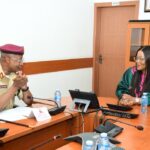
The renewed strategic alignment was cemented on February 20, 2026, when the Director-General/Chief Executive Officer of NIMASA, Dr Dayo Mobereola, paid a high-level courtesy visit to the Chief of the Air Staff, Air Marshal Sunday Kelvin Aneke, at NAF Headquarters in Abuja.
At the heart of the engagement was a shared resolve to reinforce air–maritime synergy in securing Nigeria’s territorial waters, sea lines of communication and offshore economic assets — pillars considered critical to unlocking the full potential of the country’s blue economy.
Mobereola described maritime security as the backbone of economic resilience, international trade and investor confidence, noting that Nigeria has recorded four consecutive years without piracy incidents within its territorial waters. He attributed the milestone to coordinated efforts among the Armed Forces and sister security agencies.
“This achievement has significantly strengthened Nigeria’s standing in the global maritime community and created a safer environment for commerce to thrive,” he said.
According to the NIMASA helmsman, rising maritime traffic across Nigeria’s coastal and inland waterways demands sustained vigilance, enhanced surveillance systems and rapid-response capacity. He stressed that closer operational ties with the Air Force would guarantee continuous aerial oversight, real-time intelligence sharing and proactive deterrence — crucial safeguards for maritime assets and economic infrastructure.
Responding, Air Marshal Aneke reaffirmed the NAF’s unwavering commitment to maritime security operations, outlining the Air Force’s expanding air capabilities tailored to coastal and offshore missions. These include long-range surveillance aircraft, maritime patrol-configured platforms, Unmanned Aerial Vehicles (UAVs) for persistent intelligence, surveillance and reconnaissance, as well as rapid-response air assets capable of swift deployment across Nigeria’s coastal corridors.
He explained that advanced sensors, data-link systems and inter-agency communication frameworks now enable seamless information flow and coordinated action among security stakeholders.
“Air power remains a decisive force multiplier in maritime security operations, offering speed, flexibility and reach that significantly enhance deterrence and enforcement capabilities,” Aneke stated.
Security analysts say the strengthened collaboration signals a more integrated national security architecture — one that blends air superiority with maritime enforcement to protect strategic oil and gas infrastructure, shipping lanes and critical trade corridors.
The partnership aligns with President Bola Tinubu’s economic diversification agenda focused on harnessing Nigeria’s vast maritime resources for sustainable growth, job creation and long-term prosperity.
With global trade increasingly dependent on secure sea routes, the reinforced NAF–NIMASA alliance is expected to bolster Nigeria’s credibility as a safe maritime hub in the Gulf of Guinea, positioning the country as a pivotal player in Africa’s evolving blue economy landscape.
For a nation long challenged by maritime insecurity, the message from Abuja is unmistakable: the skies and the seas are now working in concert to secure Nigeria’s economic frontier.